
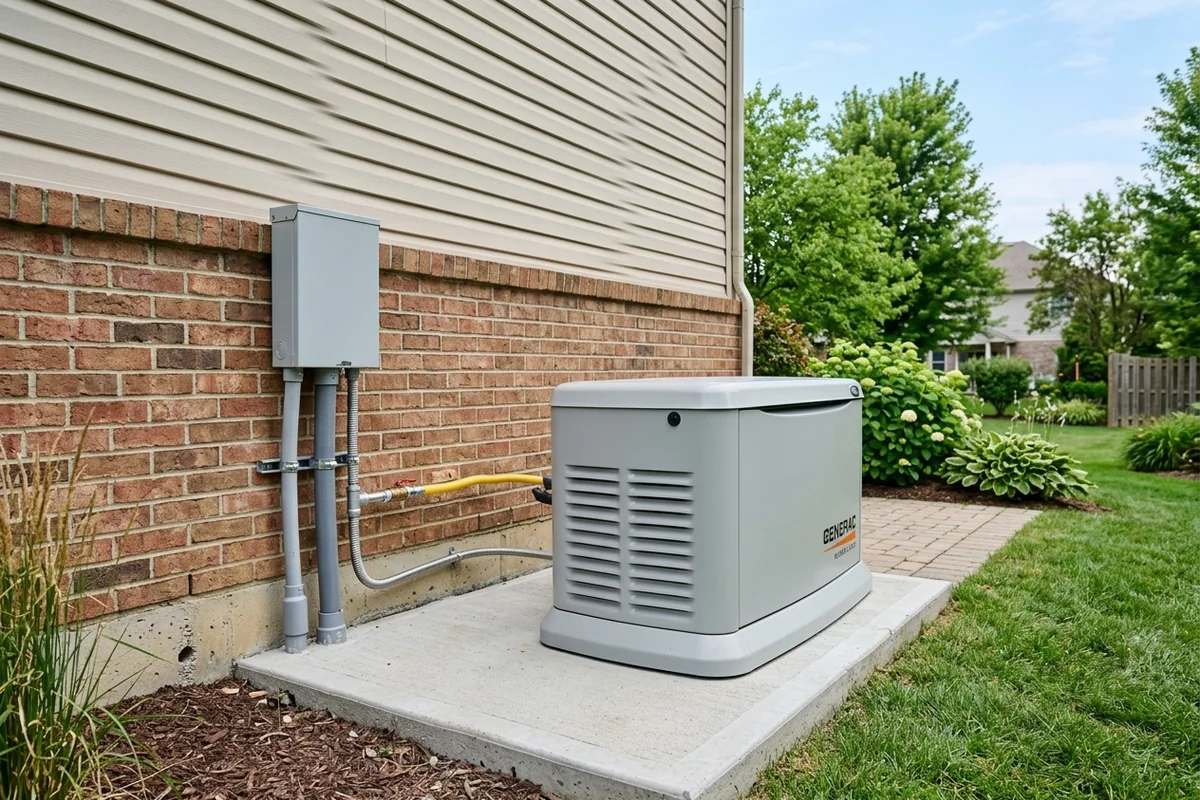
Flood & Blizzard Resilient Standby Power for Spencer & Clay County
From residential districts near Grand Avenue and the Clay County Fairgrounds to riverside neighborhoods and outlying agricultural homesteads in Fostoria and Everly, our partner Master Electricians provide complete turnkey installations: elevated flood-proof concrete pads, 200A automatic transfer switches, and direct Spencer Municipal Utilities coordination.
Spencer Neighborhoods & Surrounding Communities
Our partner network provides prompt dispatch, site evaluations, and electrical load sizing across all Spencer neighborhoods:
Spencer Permitting & Municipal Utility Requirements
Installing a standby backup generator in Spencer requires adherence to Clay County municipal codes, National Electrical Code (NEC) Article 702, and Spencer Municipal Utilities (SMU) interconnection standards:
City of Spencer Planning and Zoning
The City of Spencer (418 2nd Ave W) enforces electrical and mechanical trade codes. For properties within the Little Sioux River basin, standby generator installations must feature elevated mounting pads to protect critical electrical components.
Spencer Municipal Utilities (SMU) Coordination
Because Spencer operates its own municipal electric utility, licensed electricians must coordinate scheduled meter disconnects with SMU crews and ensure UL 1008 open-transition transfer switch compliance.
Need full details on permits, transfer switch disconnects, and utility fee schedules? Review our comprehensive Iowa Generator Cost & Permitting Guide.
Why Spencer Homeowners Need Automatic Standby Power
Little Sioux River Flood Defense
Recent catastrophic flooding along the Little Sioux River demonstrated the critical need for uninterrupted power to operate continuous high-capacity sump pumps and sewage ejectors during municipal grid outages.
Prairie Blizzard Isolation
Winter blizzards in Clay County frequently close highways and delay utility repair crews. Standby power engages in 15 seconds, keeping heating systems, refrigeration, and communications fully active.
Sub-Zero Engine Starting Packages
Our Spencer installations include cold-weather heaters for engine oil and starter batteries, guaranteeing dependable automatic startup even when ambient temperatures fall below -25°F.
Spencer Standby Generator FAQs
Straightforward answers regarding Spencer permitting, Spencer Municipal Utilities rules, sizing, and storm resilience.
How does Spencer Municipal Utilities (SMU) handle standby generator interconnection?
SMU requires licensed electrical contractors to verify transfer switch specifications and schedule a planned meter disconnect to ensure absolute grid isolation and lineman safety during power restoration.
Can standby generators be elevated to protect against Little Sioux River flooding?
Yes. In flood-prone Spencer neighborhoods, our contractors construct poured-concrete plinths or heavy-gauge galvanized steel risers elevating the generator unit 12 to 36 inches above local flood grade.
What fuel sources are available for generators in Spencer?
Within city limits, generators connect to municipal natural gas. In rural Clay County acreages, units connect to 500-gallon or 1,000-gallon on-site liquid propane (LP) storage tanks.
What size generator is needed for a whole-home in Spencer?
A 20kW to 24kW standby generator provides full whole-home backup for most 2,000 to 3,200 sq. ft. homes, easily managing central air, basement pumps, furnace blowers, and kitchen appliances.
What permits are required in Spencer, Iowa?
The City of Spencer requires an electrical trade permit for ATS installation and a mechanical trade permit for natural gas fuel plumbing and pressure testing.
What is the typical turnkey cost for a generator in Spencer?
Turnkey installation in Spencer typically ranges between $8,500 and $16,500, covering the generator, transfer switch, elevated pad, municipal trade permits, gas plumbing, and SMU utility coordination.
Nearby Iowa Service Areas
Looking for certified standby generator installations in neighboring communities? Explore our local regional hubs: