
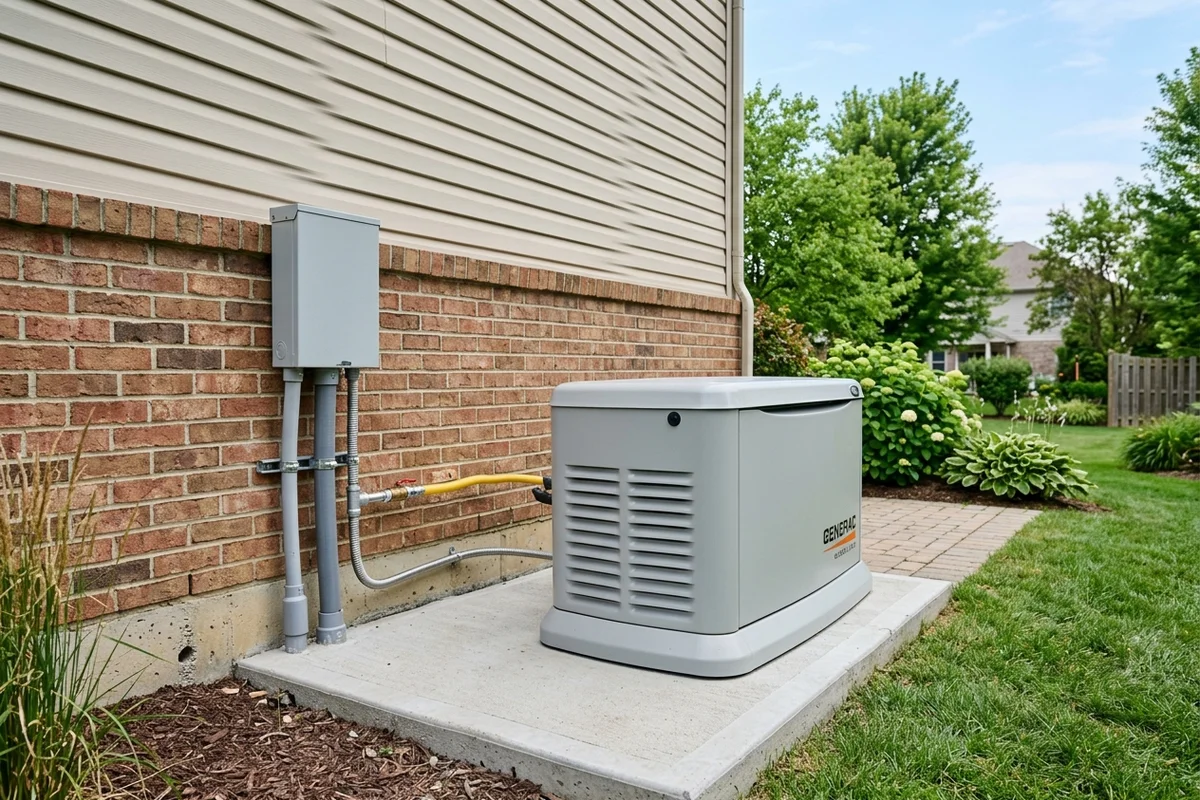
Where Does Your Investment Go?
A turnkey quote covers more than just the generator unit itself. Between 40% and 50% of the total project cost accounts for certified electrical and plumbing work required to bring the system online safely:
Complete Turnkey Installation Cost Ranges
The following table outlines standard residential pricing across Iowa for certified installations:
| System Tier | Generator & ATS Equipment | Turnkey Labor & Mechanical | Total Estimated Investment |
|---|---|---|---|
| Essential Circuit (14kW – 18kW) Ideal for 1,200–2,000 sq ft homes | $4,500 – $6,000 | $3,500 – $4,500 | $8,000 – $10,500 |
| Whole-Home Standard (20kW – 22kW) Most popular for 2,200–3,500 sq ft homes | $5,500 – $7,500 | $4,000 – $5,500 | $9,500 – $13,000 |
| Whole-Home Heavy Load (24kW – 26kW+) For large estates, dual A/C, 400A service | $7,000 – $9,500 | $5,000 – $7,000 | $12,000 – $16,500+ |
Key Cost Variables in Iowa Installations
Gas Line Distance & Meter Sizing
Generators consume high volumes of fuel under load (up to 300,000 BTU/hr). If your gas meter is located on the opposite side of your home from your electric meter, underground trenching and larger diameter pipe (1-inch or 1¼-inch) will be required.
Electrical Panel & Transfer Switch
Homes with older 100-amp split-bus panels or fuse boxes may require a service panel upgrade to 200 amps before a whole-house 200A Automatic Transfer Switch can be interconnected safely.
Cold-Weather Packages
In Iowa's climate, sub-zero cold weather kits (thermostatic battery warmers and oil pan block heaters) add $250 to $500, but are indispensable to prevent freezing engine failures during winter ice storms.
MidAmerican Energy & Alliant Energy Interconnection Rules
Interconnecting a whole-home standby generator with Iowa's power grid is strictly governed by state utility tariffs, National Electrical Code (NEC Article 702), and utility-specific safety protocols. Independent Master Electricians must adhere to the following interconnection requirements:
MidAmerican Energy Interconnection Requirements
Primary electric utility for Des Moines metro, Polk, Dallas, Warren, Johnson, and Scott counties.
- Scheduled Utility Meter Disconnect: Installing a whole-home 200A service-entrance-rated Automatic Transfer Switch (ATS) between the electric meter and main distribution panel requires an official utility meter pull. MidAmerican requires electrical contractors to submit a scheduled service disconnection work order at least 5 to 7 business days in advance.
- Mandatory Load Shedding on 200A Whole-Home Setups: Under NEC 702.4(B) and MidAmerican interconnection rules, if generator wattage (e.g., 18kW – 24kW) does not cover the residence's calculated full electrical peak, automated load-shedding modules must be installed. High-draw inductive circuits—such as central air conditioners, heat pumps, and EV chargers—must automatically drop off the line prior to generator overload.
- Gas Meter Capacity Upgrades (2-psig Regulation): Standby generators demand high fuel volume under 100% electrical load (often 250,000 to 350,000 BTU/hr). MidAmerican Energy gas engineering inspects existing residential diaphragm meters. If existing flow is insufficient, contractors coordinate a utility gas meter upgrade to a high-pressure 2-psig regulator prior to system commissioning.
- UL 1008 Double-Throw Isolation: All interconnected transfer switches must be certified open-transition, break-before-make double-throw mechanisms listed to UL 1008 standards to physically prevent grid back-feeding.
Alliant Energy Interconnection Requirements
Primary electric utility for Cedar Rapids, Linn County, Marion, Ames, Dubuque, Clinton, and Eastern Iowa rural co-ops.
- Anti-Islanding Protection Mandates: Under Iowa Utilities Board (IUB) safety regulations and Alliant Energy tariffs, anti-islanding protection is strictly mandated. The generator and transfer switch must physically isolate the premises from the distribution grid to prevent back-feeding lineworkers repairing storm damage during outages.
- Transfer Switch Compliance (Manual vs. Automatic): Alliant Energy permits both Manual Transfer Switches (with permanent mechanical interlocks) and Automatic Transfer Switches (ATS), provided they are UL 1008 listed double-throw switches. Unapproved connections (such as back-feeding via dryer circuits or DIY cords) violate Iowa administrative law and result in immediate utility meter removal.
- Utility Notification & Service Coordination: For whole-home standby installations, contractors coordinate with Alliant's local field operations center with 3 to 5 business days advance notice for planned outages, service drops, and utility meter seal cuts.
- Grounding & Neutral Bonding Verification: Alliant requires strict adherence to separately derived vs. solid-neutral system grounding standards. The transfer switch must correctly match the generator's neutral bond configuration to avoid dangerous parallel ground paths and neutral loop currents.
Polk & Linn County Generator Set-Back Codes (NFPA 37)
Stationary standby generator placement is governed by strict fire safety and building codes to eliminate carbon monoxide hazards and prevent structural fire spread. In Iowa, municipal building departments enforce NFPA 37 (Standard for the Installation and Use of Stationary Combustion Engines) alongside local zoning setbacks:
Operable Windows, Doors & Vents
NFPA 37 §4.1.4 mandates that generator engine exhaust must discharge outward and maintain a minimum clearance of 5 feet from any operable window, exterior door, dryer exhaust vent, fresh-air intake, or crawlspace vent to eliminate carbon monoxide infiltration into the home.
Combustible Exterior Walls
Standard NFPA 37 code requires 5 feet of clearance from combustible building walls (such as vinyl, wood, or composite siding). However, generator enclosures certified under full-scale fire testing (such as Generac and Kohler NFPA 37 compliant models) allow reduced clearance down to 18 inches (1.5 feet), provided roof overhangs and soffits meet local fire ratings.
Utility Meter & Service Clearances
Both MidAmerican Energy and Alliant Energy enforce a strict 3-foot radial clearance envelope in front of and to the sides of electric meters, gas meters, and exterior central A/C disconnects. Generators must never obstruct utility technician service access or emergency egress pathways.
Polk County Permit & Development Center Requirements
Serving unincorporated Polk County, Des Moines, West Des Moines, Ankeny, and Urbandale:
- Dual-Trade Permitting: Standby generator installation requires two separate trade permits: an Electrical Permit for the ATS and service panel connection, and a Mechanical/Plumbing Permit for fuel gas line extension.
- Site Plan & Zoning Verification: Applications submitted to the Polk County Permit & Development Center must include a dimensioned site plot plan detailing property boundary setbacks (typically 5 to 10 feet from side lot lines) and proximity to adjacent structures.
- Sequential Inspections: An open-trench inspection is required for buried gas piping and underground conduit before backfilling, followed by a final electrical operational test before certificate of occupancy sign-off.
Linn County & Cedar Rapids Post-Derecho Standards
Following the historic August 2020 derecho, the Linn County Building Division and City of Cedar Rapids Building Services instituted stringent resilience standards:
- Engineered Concrete Pad Anchoring: To withstand derecho-force straight-line winds exceeding 120–140 mph, unanchored lightweight plastic pads are restricted. Inspectors enforce 4-inch reinforced concrete pads or commercial composite pads securely anchored to frost-depth compacted stone subbases.
- Gas Line Trenching & Frost Depth: High-density polyethylene (HDPE) gas lines with yellow tracer wire must be buried at a minimum depth of 18 inches (24 inches under driveways and high-traffic areas) to avoid seasonal frost heave rupture in sub-zero Eastern Iowa winters.
- Observed Pressure Testing: Mechanical gas lines must pass a mandatory 15-minute pressure test at 20–30 psi observed by a municipal plumbing inspector before Alliant Energy or MidAmerican will authorize gas meter turn-on.
Frequently Asked Questions
How much does a whole-home standby generator cost in Iowa in 2026?
A complete turnkey standby generator installation in Iowa typically ranges between $8,500 and $16,500. This includes the generator hardware, Automatic Transfer Switch (ATS), mechanical concrete pad, natural gas or LP plumbing, high-amperage electrical wiring, municipal permits, and utility coordination.
Do I need a building and electrical permit in Iowa to install a generator?
Yes. All incorporated Iowa cities (such as Des Moines, West Des Moines, Cedar Rapids, and Marion) and county building departments mandate both an electrical permit for the transfer switch connection and a mechanical/plumbing permit for gas line extension. Our partner contractors manage all permitting and inspection scheduling.
What are the MidAmerican Energy standby generator interconnection rules?
MidAmerican Energy mandates that any permanently installed standby generator must utilize a certified, double-throw open-transition transfer switch to physically isolate the home electrical distribution from the utility grid. Installation of whole-house 200A service-entrance transfer switches requires scheduling a utility meter pull/disconnect at least 5 to 7 business days in advance. In addition, when generator sizing is below maximum connected household load, automated load-shedding modules must be installed to manage heavy draws such as central air conditioning.
What is the NFPA 37 clearance requirement for generators in Polk County, Iowa?
Under NFPA 37 standards enforced across Polk County and the Des Moines metro, stationary standby generators must maintain a minimum 5-foot clearance from operable windows, doors, and intake vents, and at least 3 feet from utility electric and gas meters. Clearance from combustible exterior walls is 5 feet unless the generator model has certified NFPA 37 fire-tested enclosures, which permit reduced setbacks down to 18 inches. The Polk County Permit & Development Center requires separate electrical and mechanical permits verifying these setbacks.
Does Alliant Energy require an automatic transfer switch for home generators?
Yes. Alliant Energy strictly enforces anti-islanding safety mandates under the Iowa Administrative Code and utility interconnection rules. While code permits either a manual transfer switch with mechanical interlock or an Automatic Transfer Switch (ATS), Alliant requires the transfer mechanism to be a break-before-make design certified to UL 1008. This ensures impossible accidental back-feeding into downed neighborhood utility lines during widespread storm outages.
Does MidAmerican Energy or Alliant Energy offer rebates for standby generators?
While primary electric utilities generally do not offer direct purchase rebates on standby generators (since they operate on private fossil fuels), some local agricultural cooperatives and gas utilities offer high-efficiency appliance incentives or special rates for dual-fuel systems. Additionally, continuous power protects against thousands of dollars in burst pipe repairs.
How far must a standby generator be placed from my house in Iowa?
According to NFPA 37 standards adopted in Iowa, stationary generators must be placed at least 5 feet from operable windows, doors, vents, and combustible walls, and at least 3 feet from electrical utility meters. Specific municipal zoning setback rules in your town may also dictate distance from property boundaries.
Can I run my generator on natural gas instead of propane?
Yes. If your Iowa home has natural gas service through MidAmerican Energy, Alliant Energy, or a municipal utility, your generator can connect directly to your gas meter with a flexible high-flow line. If gas meter pressure is insufficient, our partners coordinate with your utility for a 2-psig meter upgrade.